

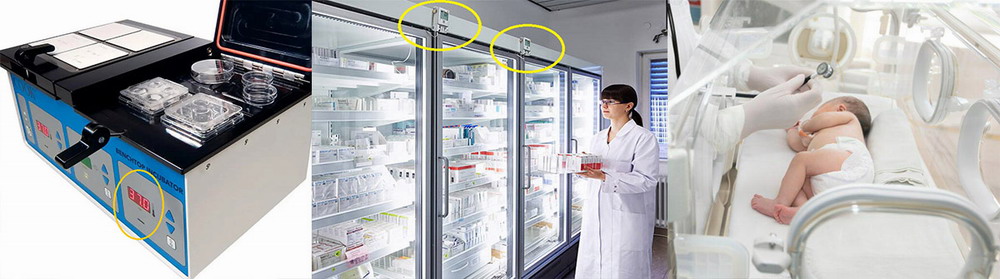
Okay, this is a very professional and important question. Selecting temperature sensors for infant incubators, pharmaceutical refrigerators, and drug transport containers requires an extremely rigorous approach, as it directly relates to patient safety and drug efficacy.
In summary, selecting these types of medical temperature sensors should follow a core principle: Choose the most suitable type and solution based on the specific application's priorities (such as response speed, anti-interference, data logging requirements) under the premise of meeting extreme stability and accuracy requirements.
The following are key aspects to focus on, with analysis for the three specific application scenarios you mentioned:
1. Core Performance Parameters
- Accuracy and Stability
- Accuracy: The closeness of the measurement to the true value. For infant incubators and vaccine storage, typically ±0.1°C or higher is required. Drug transport may allow slightly lower accuracy (e.g., ±0.5°C), but critical pharmaceuticals also demand high precision.
- Stability/Drift: The sensor's ability to maintain its accuracy over time. This is one of the most important metrics. It is essential to choose sensors with minimal annual drift; otherwise, frequent calibration is needed. Platinum Resistance Temperature Detectors (RTDs) (Pt100 or Pt1000) are the preferred choice due to their exceptional long-term stability.
- Response Time
- The speed at which the sensor reacts to a temperature change, often expressed as a time constant (e.g., T90).
- Infant Incubators: Require a relatively fast response time to promptly react to changes in the compartment environment or the infant's temperature.
- Pharmaceutical Refrigerators: The requirement for response time is relatively lower, as the internal temperature is usually stable.
- Drug Transport: Requires medium to fast response times to accurately capture temperature fluctuations caused by door openings/closings or changes in the external environment.
- Measurement Range
- Must cover all extreme temperatures the application might encounter, with a safety margin.
- Infant Incubators: Typically around ambient +5°C to 40°C.
- Pharmaceutical Refrigerators: Depending on the drug type, common ranges are 2-8°C (refrigerated), 15-25°C (room temperature), or -20°C / -80°C (frozen).
- Drug Transport: The widest range, potentially from -50°C (dry ice transport) to 40°C (extreme environments).
- Reliability and Lifespan
- Medical applications require sensors with very low failure rates. Choose robust, fatigue-resistant designs.
- MTTF/FIT Rate: Understand the sensor's Mean Time To Failure and Failure In Time rate data.
2. Regulations and Compliance
- Medical Device Regulations
- If the sensor is part of a medical device (like an incubator), it must comply with relevant medical device regulations, such as China's NMPA, US FDA 510(k) (if applicable), and the EU's MDR.
- Requires complete traceability and validation documentation.
- Calibration and Traceability
- Sensors must be calibratable, and the calibration chain must be traceable to national or international standards (e.g., NIST, PTB).
- The calibration certificate should state the uncertainty.
- Good Practice Guidelines
- The selection, installation, calibration, and maintenance of sensors used in pharmaceutical refrigerators and transport must comply with GxP (including GMP, GSP) requirements. This emphasizes documentation, procedures, and traceability.
3. Technology Type Selection
- Platinum RTD Sensors
- Advantages: High accuracy, high stability, good linearity, strong interchangeability. The gold standard in medical and pharmaceutical fields.
- Application: The absolute mainstay for infant incubators, high-precision pharmaceutical refrigerators, and validation monitoring systems.
- Thermistors
- Advantages: High sensitivity (large resistance change), fast response, low cost.
- Disadvantages: Non-linear, narrower measurement range, significant unit-to-unit variation (requires individual calibration).
- Application: Often used in cost-sensitive applications or where fast response is needed; used in some medical devices but requires careful design and calibration.
- Thermocouples
- Advantages: Very wide measurement range, rugged, low cost.
- Disadvantages: Relatively lower accuracy, requires cold junction compensation, weak signal.
- Application: Less common in medical fields, except for extreme high temperatures (e.g., sterilization) or special research applications.
- Digital Semiconductor Sensors
- Advantages: High level of integration, easy digital interface communication, low cost.
- Disadvantages: Accuracy and stability are generally lower than platinum RTDs, slower response.
- Application: Often used in consumer-grade or some industrial-grade applications with less stringent accuracy requirements; use in critical medical fields requires rigorous evaluation.
Conclusion: For these three applications, Platinum RTDs (Pt100/Pt1000) are the preferred and most reliable technology.
4. System Integration and Functionality
- Probe Form Factor and Installation
- Infant Incubators: The probe must be placed in a location representative of the infant's average ambient temperature and must not be in direct contact with the infant. The housing material must be non-toxic, biocompatible, and easy to clean and sterilize.
- Pharmaceutical Refrigerators: Requires measurement at multiple points (coldest spot, warmest spot, door area) to map the temperature distribution. Probes must be securely installed at key locations.
- Drug Transport: Probes need to be rugged, shock-resistant, and placed inside the cargo to measure the core temperature.
- Alarm Functionality
- The system must immediately trigger audible and visual alarms when temperatures exceed set high/low limits, and be capable of remote notification via SMS, email, etc.
- Alarm records must be traceable.
- Data Logging and Traceability
- Must have data logging functionality with a configurable recording interval (e.g., 1-10 minutes).
- Data should be exportable and not easily modifiable to meet GxP audit requirements. For transport, GPS location and tracking should also be recorded.
- Power Supply and Battery
- For transport containers, battery life is critical. It is necessary to evaluate battery performance under extreme temperatures and ensure sufficient power for the longest transport mission.
5. Supplier and Support
- Choose suppliers with a good reputation and extensive experience in the medical or pharmaceutical industry.
- Ensure the supplier can provide complete technical support, calibration services, and compliance documentation (e.g., material certificates, calibration certificates, ISO 13485 quality management system certification).

Scenario-Based Summary
|
Feature |
Infant Incubators |
Pharmaceutical Refrigerators (e.g., 2-8°C) |
Drug Transport Containers |
|
Core Priority |
Infant Safety, Real-time response, Stability |
Regulatory Compliance, Data Integrity, Stability |
Environmental Robustness, Battery Life, End-to-End Traceability |
|
Recommended Sensor |
High-Precision Platinum RTD (Pt1000) |
High-Precision Platinum RTD (Pt100/Pt1000), Multi-point monitoring |
Ruggedized Platinum RTD or High-Reliability Thermistor |
|
Accuracy Requirement |
Extremely High (±0.1°C) |
High (±0.2°C ~ ±0.5°C) |
Depends on the drug, typically ±0.5°C |
|
Response Speed |
Fast |
Medium |
Medium to Fast |
|
Key Features |
Real-time display, high audio/visual alarms, automatic over-temperature protection |
Multi-point monitoring, timestamped data logging, audit trail, alarms |
GPS tracking, long battery life, shock/water resistance, cloud data upload |
|
Compliance |
Medical Device Regulations (e.g., FDA, MDR, NMPA) |
GxP (GMP, GSP) |
GxP (especially GSP - Good Supply Practice) |
Final Recommendation:
Before making a final selection, it is strongly advised to conduct rigorous performance validation and risk assessment. Especially for new suppliers or sensor models, long-term testing under conditions consistent with actual use should be performed to ensure they fully meet all technical and regulatory requirements.
Post time: Oct-31-2025