

A thermistor is an electronic component whose electrical resistance changes significantly with temperature. In motor protection, the most commonly used types are Positive Temperature Coefficient (PTC) thermistors and Negative Temperature Coefficient (NTC) thermistors. They serve the core protective function of temperature monitoring and overload protection in distinct ways.
Core Protection Principle: Sensing Temperature, Cutting Off the Circuit
The vast majority of motor failures ultimately manifest as overheating. Causes of overheating include:
- Overload: Excessive load causing current to exceed the rated value.
- Locked Rotor: The motor shaft is jammed, leading to a sharp rise in current.
- Phase Loss (in three-phase motors): Loss of one power phase causes unbalanced currents and heating.
- Poor Cooling: Damaged cooling fan or blocked ventilation.
- Frequent Starting/Stopping: Accumulated heat cannot dissipate in time.
The role of the thermistor is to directly measure the temperature of the most critical part of the motor—the motor windings—thus providing fundamental prevention against burnout caused by the issues above.
1. Application of PTC Thermistors in Motor Protection
PTC thermistors are characterized by their low resistance below a specific temperature (the Curie temperature point). Once the temperature exceeds this critical point, their resistance increases dramatically (a "step-like" increase).
How It Works:
- Embedding: Typically, three PTC thermistors (for the three windings of a three-phase motor) are directly embedded into the motor's stator windings, right against the enameled wire, to most accurately and quickly sense winding temperature.
- Series Connection: These PTC thermistors are connected in series and linked to an external control circuit (often called a thermistor relay or motor protector).
- Normal State: During normal motor operation, winding temperature is below the critical point. PTC resistance is low, and the control circuit detects this low resistance, considers the state normal, and keeps the main circuit contactor engaged.
- Overheat Trigger: When the motor overheats for any reason, and the winding temperature reaches or exceeds the PTC's critical point, at least one PTC's resistance increases sharply.
- Action: The control circuit detects that the total resistance of the series circuit exceeds a preset threshold and immediately outputs a signal to cut power to the main circuit contactor, thereby stopping the motor and providing protection.
- Auto or Manual Reset: When the motor cools down, the PTC resistance returns to a low value. The protector can then automatically or manually reset to allow the motor to restart.
Suitable Motor Types:
- Three-Phase Asynchronous Motors (Squirrel-cage or Wound-rotor): The most common application for PTCs, especially in low to medium power motors.
- Servo Motors: High-precision servo motors are extremely sensitive to overheating; built-in PTCs are standard protection.
- Heavy-Duty Motors (e.g., for cranes, metallurgy): Motors in harsh conditions with variable loads require direct temperature protection.
Advantages:
- Direct Temperature Measurement: Directly reflects winding temperature, more accurate and reliable than estimating thermal models from current (like traditional thermal overload relays).
- No Settings Required: The critical temperature is determined by the component itself; no need to adjust current settings after installation like with thermal relays.
- High Reliability: Semiconductor component, long lifespan, resistant to vibration.
2. Application of NTC Thermistors in Motor Protection
NTC thermistors have the opposite characteristic to PTCs: their resistance decreases smoothly as temperature increases.
How It Works:
- Embedding: Similarly embedded into the motor windings.
- Voltage Divider Measurement: The NTC is typically part of a voltage divider circuit. The control circuit continuously monitors the voltage change across it.
- Temperature Conversion: By measuring the NTC's resistance, the control system can precisely calculate the current temperature. This is an analog signal.
- Intelligent Judgment: The control system (e.g., PLC, dedicated drive controller) makes intelligent decisions based on the read temperature value:
- Issues a warning without shutdown if a first-level alarm threshold is exceeded.
- Immediately commands the drive to stop output if a dangerous second-level shutdown threshold is reached.
- Can even participate in closed-loop temperature control, such as controlling the operation of cooling fans.
Suitable Motor Types:
- Motors requiring continuous temperature monitoring and control: e.g., Inverter-Driven Motors. Variable Frequency Drives (VFDs) can easily accept NTC signals as one of their multi-function inputs for advanced protection.
- Large High-Voltage Motors, Critical Pumps, Fans: These assets require continuous temperature monitoring and data logging for predictive maintenance.
- Motors integrated into servo drive, VFD systems: Modern drive systems commonly support NTC temperature feedback interfaces.
Advantages:
- Continuous Monitoring: Provides continuous, precise temperature readings, not just an "overheat/not overheat" switch signal.
- Multifunctionality: Can be used for alarms, shutdowns, cooling control, and other functions.
- Data Output: Temperature data can be uploaded to monitoring systems for asset health management.
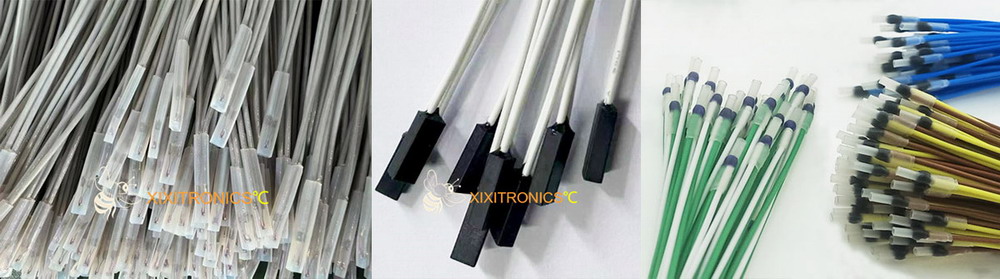
3. Summary Comparison and Application Scenarios
|
Feature |
PTC Thermistor |
NTC Thermistor |
|
Working Principle |
Switch/Digital. Resistance increases sharply above threshold, triggering a switch action. |
Analog. Resistance decreases smoothly with rising temperature, allowing precise reading. |
|
Output Signal |
Switch signal indicating "Normal" or "Overheat" |
Continuous analog voltage/resistance signal corresponding to specific temperature |
|
Circuit Complexity |
Simple, only requires a threshold detection circuit |
Relatively complex, requires ADC (Analog-to-Digital Conversion) and calculation |
|
Primary Function |
Overheat protection shutdown |
Temperature monitoring, alarm, shutdown, control |
|
Cost |
Lower |
Relatively higher (due to more complex processing circuitry) |
|
Typical Application |
Basic overheat protection for general-purpose 3-phase AC motors, servo motors |
Continuous temperature monitoring and advanced protection for inverter-duty motors, large critical motors |
Comprehensive Protective Role in Different Motors
In practical applications, motor protection is often multi-layered:
- 1. First Line of Defense: Current Protection (e.g., thermal overload relays, magnetic trip of circuit breakers, drive overcurrent settings) – Fast response, prevents short circuits and severe overloads.
- 2. Second Line of Defense: Temperature Protection (Thermistors) – Acts as the ultimate and most reliable protection. When current protection fails to act (e.g., slow overheating due to poor cooling) or when current protection settings cannot precisely match the motor's thermal characteristics, the direct temperature measurement provided by thermistors offers an irreplaceable, final protective barrier.
Conclusion:
The core protective role of thermistors (both PTC and NTC) in various types of motors is to prevent insulation damage or burnout due to overheating by directly sensing winding temperature. PTC acts like an auto-resetting "temperature switch," simple in structure, economical, and reliable. NTC acts like a "temperature gauge," providing continuous data for smarter control
Post time: Sep-06-2025